
When Family Becomes a Risk: How Baltic Employees with Children Face Discrimination at Work
A new Alma Career survey among employees in Lithuania, Latvia and Estonia shows that parenthood can still be perceived as a “risk” in the labour market – not only when applying for a job, but also in career progression and in the day-to-day organisation of work. Many parents report limited opportunities for growth, while their childless colleagues feel they carry an unfair share of the workload.
The online survey took place in October 2025 in all three Baltic countries, with 2,301 respondents in total. It focused on experiences of discrimination in the labour market, especially how parenthood influences hiring, working conditions and career development.
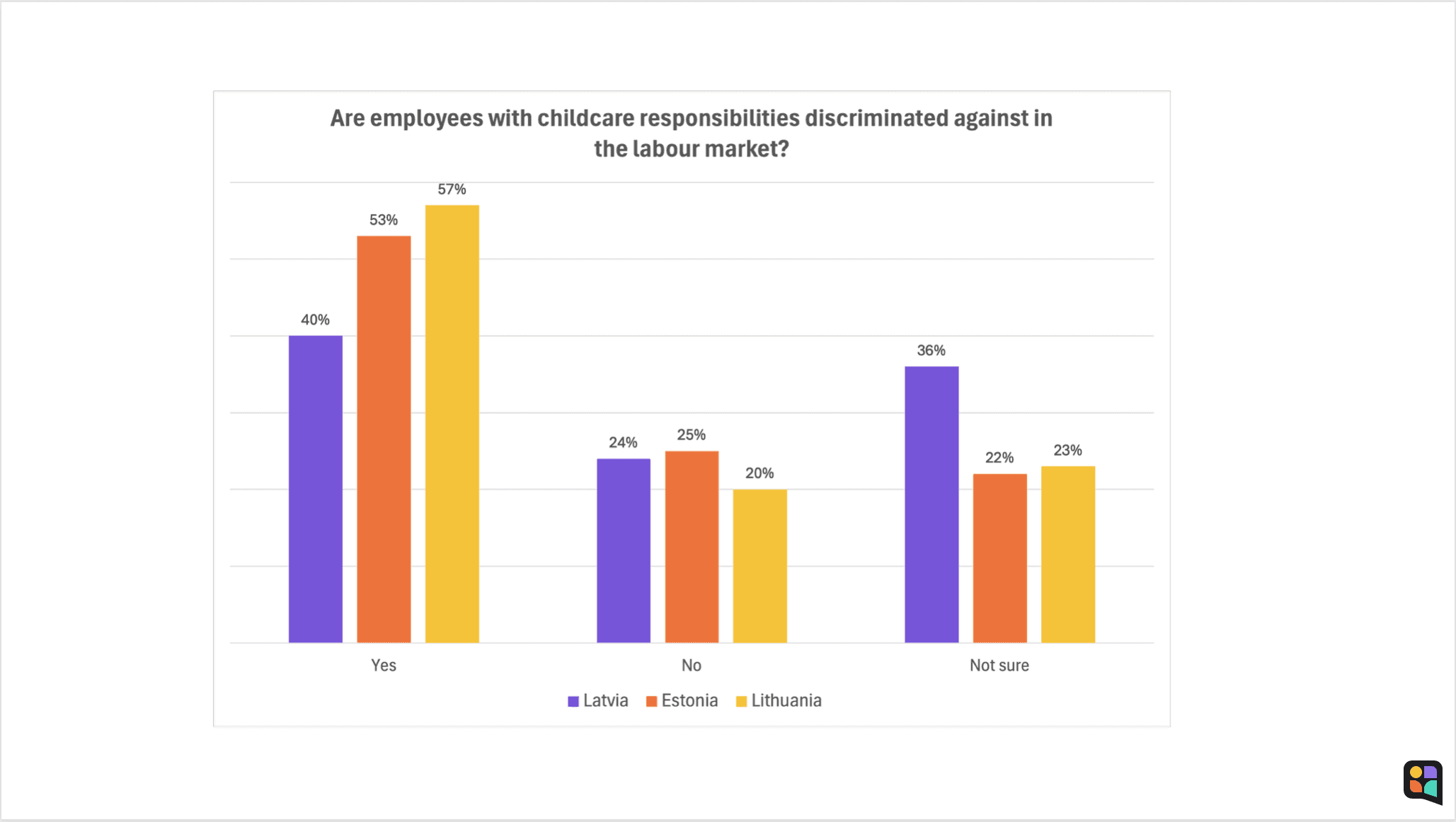
A significant share of employees in each country believes that parents face discrimination: 40% of employees in Latvia, 53% in Estonia and 57% in Lithuania hold this view. More than 90% of respondents in every country say that they have either personally experienced discrimination related to parenthood or know someone who has.
In Latvia, there is a large group of employees who are unsure whether parents are discriminated against at all – 28% among working parents and as many as 39% among childless employees. This “invisible” nature of discrimination means it is rarely discussed in teams, is not clearly named, and there is a lack of open conversations about fair conditions for both parents and childless employees.
“The survey data shows divided public opinion – 40% see discrimination, 24% deny it, and 36% are unsure. The fact that more than a third of Latvian employees don’t know whether discrimination exists is almost as concerning as discrimination itself. It indicates that discrimination is a ‘silent’ issue – one that is rarely openly discussed, and employees may not always recognize or identify it,” emphasizes Krista Roziņa, Head of Marketing and Communications at Alma Career Latvia.
Parents most often describe problems during recruitment processes, after returning from parental leave and when being offered less favourable working conditions or positions. Childless colleagues, on the other hand, report higher workloads and an expectation that they will be more flexible and available “because they do not have children”, which creates a sense of unfairness in this group as well.
“These results reveal dual-sided discrimination – parents often feel limited in their career growth, while childless workers feel overloaded, as they are expected to be more available and flexible. The survey data confirms the need for a broader dialogue and understanding of equality in the Baltic labour market. Employers must foster an inclusive culture, where responsibilities and flexibility are distributed based on actual capacity, not assumptions. Companies that achieve this balance will benefit from more loyal and motivated employees in the long run,” notes Roziņa.
What inclusive employers can do
Put in place transparent, measurable criteria for recruitment, promotion and allocation of benefits so that parenthood or childlessness do not play a hidden role in decisions.
Distribute work and flexibility based on real capacity and competencies, not on stereotypes, and hold regular team conversations about work–life balance and fair workload sharing.
Fair conditions for both parents and childless employees are crucial for loyalty, motivation and long-term retention of talent, especially in regions with demographic challenges. Organisations that address parenthood and work–life balance openly become more attractive to diverse talent and are better aligned with the principles of inclusion that are at the core of Alma Inclusive’s mission.

