How employees view diversity: what a survey in 8 countries revealed
In 2025, Alma Career Slovakia, in cooperation with PricewaterhouseCoopers Slovakia and the salary portal paylab.com, carried out an international survey on workplace diversity, equity and inclusion (DEI). We wanted to know how employees feel when working with diverse colleagues, whether they experience discrimination, and to what extent they perceive their work environment as fair.
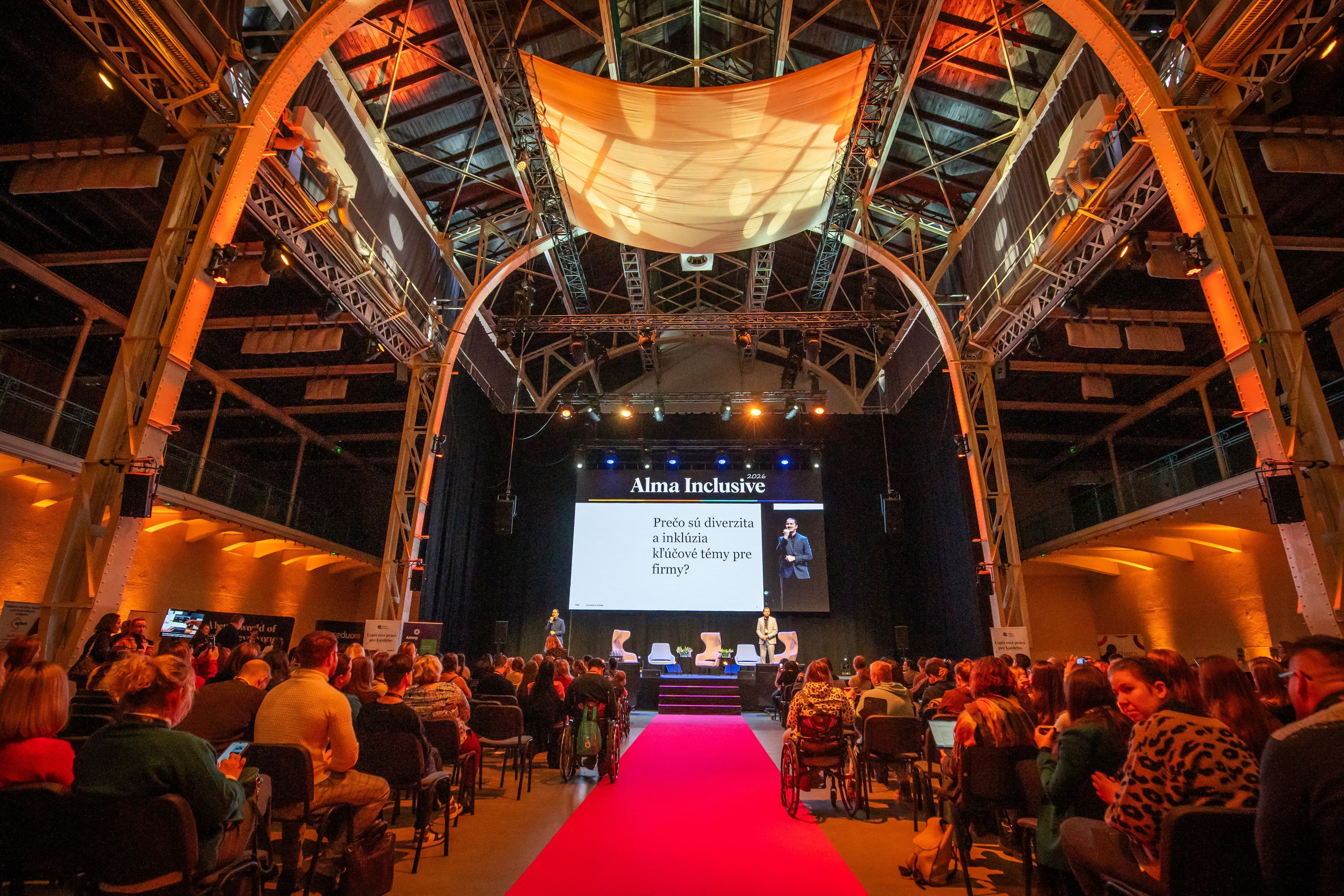
Photo from the Alma Inclusive 2026 conference: https://www.adamkovac.com
More than 10,000 respondents from eight countries took part in the survey: Slovakia, Czechia, Latvia, Lithuania, Estonia, Croatia, Bosnia and Herzegovina, and North Macedonia. We also analysed the countries in clusters (Central Europe, Baltics, Balkans) to better understand regional specificities.
1. Comfort with diversity: Slovakia is open, but the topic is still sensitive
We asked: “How pleasant is it for you to work with colleagues whose background, identity or views differ from your own?” – for example nationality, disability, gender identity or age.
In Slovakia, 29 % of respondents answered “very pleasant” and 27 % “somewhat pleasant” when working with diverse colleagues.
At the same time, as many as 33 % chose “I prefer not to answer” – the highest share among all countries.
This result shows a paradox: on the one hand, we have an above‑average willingness to work with different groups of people; on the other hand, the high share of “I prefer not to answer” suggests that the topic is sensitive and that psychological safety is lower. For companies, this means that it is not enough to have a diversity strategy “on paper” – they need to actively build trust, open communication and a safe environment.
2. Fairness and feeling of disadvantage: most people do not perceive inequality
Another question asked: “How often have your colleagues felt that they were disadvantaged at work because they do not belong to any special group that the company is trying to support?”
As many as 67 % of employees in Slovakia answered “never” and 23 % “rarely”.
In the other countries, the average share of “never” was 69 %, so Slovakia is very close to the overall average.
Most employees therefore do not see support for specific groups (e.g. parents, people with disabilities) as unfair favoritism towards others. At the same time, however, these topics are often discussed only marginally, so not all needs become visible.
3. Who is present in teams – and who is missing
The survey also asked which groups of colleagues people actually work with.
In Slovakia, there is significant age diversity: 47 % of respondents work with colleagues over 55.
As many as 61 % work with parents of children under 10, which is similar to the Baltics and the Balkans.
Contact with people with disabilities is around 11 %, with the LGBTI+ community 13 %, and with migrants also around 11 %.
This means that some groups are very visible in the workplace (for example parents), while others are almost invisible. When natural diversity is low, the risk of stereotypes and “invisible disadvantage” increases – people who do not belong to the dominant group may not feel fully included.
4. Silence about diversity: 65 % say it is not discussed at all
When asked which type of diversity is discussed most often at their workplace, respondents in Slovakia mentioned mainly age and generations, or socio‑economic background.
However, as many as 65% said that none of the listed diversity topics are discussed at their work at all – a result similar to the Baltics and the Balkans. According to PwC, this is not a sign that diversity has been “solved”, but rather that there is a lack of safe space and shared language for open dialogue.
5. What this means for companies
The conclusion of the survey is clear: countries, including Slovakia, declare openness, but in practice we see limited diversity and little discussion of sensitive topics.
For organisations, this leads to several recommendations:
Work with both parts of “D&I” – not only setting quotas and KPIs for diversity, but also systematically building an inclusive culture and psychological safety.
Make diversity visible – for example through internal communities, mentoring, networking and regular communication about why inclusion is a benefit for everyone, not a threat for some.
Foster open dialogue – instead of silence, create space for questions and sharing experiences, and support leaders to lead by example.
If companies focus only on the “D” (numbers, recruitment, statistics) and neglect the “I” (culture, behaviour, safe space), their diversity strategy will fail in the long term. Successful organisations combine short‑term goals with long‑term work on culture – and these data can help them design their next steps.

